Monday, June 22, 2015

Greening Daegu

In any given task, setting your priorities right always comes with great rewards. In Daegu, many of its citizens have long enjoyed the perks of having clean waterways - a result of giving priority to rehabilitate dying rivers and revive the city into a sustainable green hub.

But back in the early eighties, the scenario was contrary to what it is now. The rapid economic development and population explosion brought Daegu’s most important waterways – the rivers of Geumho, Sincheon and Nakdong – to utter degradation. With high BOD (or biological oxygen demand that measures the degree of water pollution) levels, the rivers were on the brink of dying. In 1984, the downstream portion of the Geumho River was considered dead, with a BOD level that rose up to 111 mg/dL – a condition no longer viable to sustain aquatic life.

The Sincheon river flowing through the heart of the city. (photo # 1)

The next ten years saw the city’s aggressive efforts to restore the rivers’ degraded ecosystem. A total of 1.2 trillion KRW was released from the city’s coffers, from 1983 to 2000, for rehabilitation projects and construction of sewage treatment plants to prevent wastewaters from entering the waterways. One of these is the Sincheon Sewage Treatment plant, which has become the country’s best facility, setting the benchmark for efficiency.  

In 1999, fifteen years after being declared dead, the Geumho River began springing back to life, with the BOD level dropping to 5.1 mg/dL. Common carps and Prussian carps started to find their way back to their habitats. Surprisingly, there have been reports about sightings of otters – an endangered species that thrives on freshwater environments, along Sincheon River. The city’s massive rehabilitation efforts have paid off, having brought back a vulnerable water species back to its home ground.
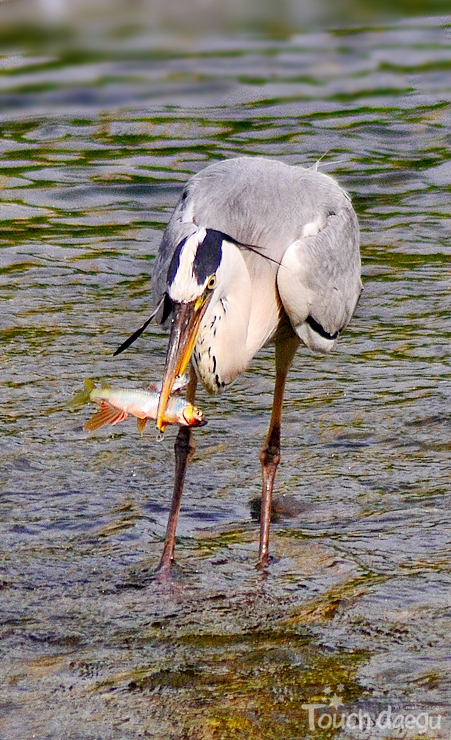
A heron's hearty lunch. (photo # 2)

It was a feat unparalleled. In Britain, it took 141 years of rehabilitation for the salmon to return to Thames River. In Germany and Japan, it took 23 years to improve water quality of the Rhine and Dama Rivers, respectively.

Making a resolve against environmental degradation is one “politically inconvenient” problem. But Daegu chose to face the challenge, and the world noticed that. In 2006, the Asia-Pacific Forum for Environment and Development recognized Daegu’s painstaking efforts to improve water quality. In April this year, the city was a proud host to the 7th World Water Forum, attended by 30,000 participants from 170 countries.


Daegu has now become an engine of growth and innovation, and that sprang from setting priorities right, and from giving premium to what really matters to become a sustainable city of the future.


Photo credits:

Monday, June 15, 2015

Want to be happy? Read!

A recent read about this thing called bibliotherapy - the practice of reading books for therapeutic effect - sent me some ripples of excitement. Growing up with an unremitting appetite for books, I know how it was like to be consumed, as if losing some sense of self, by a work of fiction. And this one - Can Reading Make You Happier? by Ceridwen Dovey for The New Yorker, came as a validation of that feeling, of being carried away into another realm of the universe. Reading fiction, Dovey says, “is one of the few remaining paths to transcendence, that elusive state in which the distance between the self and the universe shrinks”.

It sure is, undoubtedly. And I feel elated by all the voracity for books I seem to have bequeathed to my two young daughters. I have seen them salivate at the mere mention of dropping by bookstores each time we get downtown; how they drool at each new Neil Gaiman or Madeleine L’Engle that come out fresh into the shelves.


They devour books – like Liesel Meminger in Markus Zusak’s The Book Thief - ravenous for stories that transport them into new worlds and people who lived exciting lives. They relish the joys and grief of the stories like they have personally lived them. 

They knew, like Roald Dahl's famous protagonist Matilda, that if you read Jane Austen or Frank Baum, you’d find out there’s more to life than getting up every day for work or school, and that some grown-ups aren’t really grown-ups after all. I admit I get them miffed sometimes, and they retreat to their books for comfort. Unwittingly, bibliotherapy has been around the house for years.


Bibliotherapy, however, is not an escape from reality to an imaginary world. Books are much more than being a frigate than can transport you to some magical place. They draw you to self-awareness, make you bleed with ideas that either conform or disagree with each compelling story, or move you into action.

I came to love running even more because of Haruki Murakami’s What I Talk About When I Talk About Running – a beautiful memoir about his obsession with running and writing. When my body is unwilling, his words resonate in my head, like a muse to some sluggish novelist on a writer’s block. 

There’s so much about a day’s passing, but despite the blistering summer heat, weariness at work, coffee running out, ineptness to put thoughts into words, there are always stories from Umberto Eco, John Steinbeck, and Alice Munro to name a few. 


But most, if not all of my favorite books by Filipino authors aren’t meant for bibliotherapy. They turn me into something else: a Filipino, infuriated by the exasperating slack in the country's development. But despite the frustration, they developed in me a heightened sense of patriotism . F. Sionil Jose’s five-book series, the Rosales saga, gave me a deeper grasp of colonialism, how it robbed the Filipinos of cultural integrity, and a realization where I stand in the immense economic and political divide in my country. 

But there is still some sort of therapy in it. My Filipino soul, broken and lost by years of foreign dominance and the distressing economic quagmire, is eased by F. Sionil’s account of Istak’s bravery in Po-on. I want it transmitted to me, like a viral contagion, so I can stand in valor against what ails my country.

In this case, bibliotherapy serves not only to heal the self, but a broken nationalist spirit as well.

Sunday, May 24, 2015

Korea’s love of beauty

I didn’t know what a BB cream was, until I came to Korea. This mecca of beauty industry has been into a remarkable surge of sales of cosmetic products, and much of that boom is powered by consumers willing to do anything for good, flawless skin. In fact, beauty has become an obsession; looking good is a matter of utmost importance, especially for the younger Koreans.


Korea is now at the forefront of beauty industry, amassing millions of dollars in revenues. In Daegu, the hosting of the 2015 Beauty Expo at the EXCO is a showcase of the Korean innovation for beauty and wellness, with over a hundred participating companies. 


I came with a fellow Touch Daegu blogger to cover the event, along my sister, my two daughters and a niece on the second day of the event. It was delightfully engaging for me, for it turned out to be a perfect venue for crowd watching, as I am not a cosmetic junkie. My skincare regimen involves just the basic - cleansing and moisturizing - which is so unlike the Koreans’ multiple skincare ritual. A multi-step process means several skincare products in a day - a cleanser, an exfoliator, a refresher, the essence (which is considered the most important step), the ampoule (or serum), the sheet mask, an eye cream, a moisturizer, a night cream, etcetera. It’s a seemingly unending ritual of self-pampering. 


The colorful array of cosmetics, nail art stuff, hair accessories, wigs, and health and wellness gadgets such as those used for Pilates and hyperbaric therapy left us wide-eyed in amazement. And we were delighted to find people doing the Zumba at the west side of the hall. The fervor of the dancers on stage was contagious. The dancers have apparently sweated their way off to their beautifully toned bodies through a whole lot of dancing and exercising.


My daughters and niece had a great time, at the makeover area, where everyone walks out spruced up. Next to the makeover area is a wedding exhibitor. You get to try one of their gowns, so lovely even ajummas line up for their chance to feel like pretty brides and have their photos taken by the official photographer. 


The day’s event inside the exhibition hall was a microcosm of the country’s love affair with aesthetic values, a love that has translated into economic gain for the country. Of course, for a country that was able to make itself over economically in a just a few decades, it is not surprising that it is also the capital of cosmetic industry.


Saturday, May 9, 2015

A new line

Our blog gets a face-lift and a new name. The Red Line is a fitting name; red means blood, and blood means life. But just the same, we will muse about life’s discoveries – of family and friends, of dogs that become family, of experiences and adventures that evolve into life’s greatest lessons. The thing about life is to see the world with interest, see the possibilities, see the humanity in every person we meet.

The Red Line is also about things we stand up blood-and-guts for – an ideology, a personal belief, or a worthy cause. At the same time, we stand up in thundering rage against prejudice and inequality, and that’s going to be our most important voice.


This month, we also start blogging for Daegu, with a team of foreign bloggers commissioned by the city government. Two weeks ago, we received our press badges and got ourselves whisked away to a place called Sacheon, a city in the province of Gyeongsangnam. Sacheon is a quiet, laid-back city that lies against a backdrop of mountains and faces a horizon where the sky meets the sea. 


It was a wonderful experience, waking up to a cold morning watching a white tugboat gliding underneath the lovely Samcheonpo bridge, and quietly disappear behind one of the tiny islands dotting the bay. 


Blogging for Daegu is off to a good start. The trip to Sacheon brought renewed enthusiasm to get back into writing, like waking up from a long, cold winter sleep. 

We’re on for some great adventures, and The Red Line is here to tell the story.

Thursday, October 30, 2014

The contemporary Asian artworks of Lee Bae, Jung Yeongdoo and Wang Qingsong

The first time I made a visit to the Daegu Art Museum was for the solo exhibition of the celebrated avant-garde artist Kusama Yayoi – one of the most important living forerunner of pop art to come out of Japan. I had a fill of her obsession with polka dots – plastered on canvasses, walls, and bizarre figures – all tangible evidences of her creative mind. 

I came back to the museum weeks ago, this time on a field assignment commissioned by Colorful Daegu - a government organization that runs the official webpage of Daegu City. And this time, the museum comes even more replete with contemporary Asian artworks of Lee Bae and Jung Yeondoo - two of Korea’s representative artists, and Wang Qingsong from China. 

Paris-based artist Lee Bae showcased his obsession in all his works: charcoal. 

A Korean photographer/blogger attends to an important 
phone message near Lee Bae's abstract artwork.

In this untitled work reminiscent of Jackson Pollack’s drip painting technique, Lee Bae expresses abstractionism using the medium that puts him in touch with his roots. In Korea, charcoal is traditionally considered as life’s energy source. 

Charcoal in ominous shapes mounted on the wall.

These skull-shaped wall sculptures, made of small pieces of charcoal, show his sense and interpretation of space. As Henri-Francois Debailleux wrote in his review of Lee Bae’s 2011 exhibition at the Musee d’Art Moderne in Saint Etienne, France, these works accentuated the “extraordinary power of black”.

Another Korean artist who has gained wide public interest is Jung Yeongdoo, whose art is focused on ordinary people’s perception of reality and dreams. His Wonderland is a series of photos recreating children’s art into real life.


Wang QIngsong’s works are satiric depiction of the current reality in China – lost in the entanglement of capitalism and the influence of Western culture. This photograph, One Dream, One World is a potent expression of his disdain at the profit-oriented multinational corporations and the consequent deluge of consumerism. 

One World, One Dream 1000 x 800

Follow You 640 x 384

In Follow You, the artist depicted the excessively structured education system in China, leaving many students disgruntled and unable to appreciate the true learning process.

These great artists have significantly contributed a cachet to Asian contemporary art scene and will be remembered for their powerful, and often mischievous expressions of their artistry. The audiences who come to get their fill of the “food for thought” evoked by each piece of artwork will certainly leave gratified.

* Photo credits:
http://www.yeondoojung.com/artworks_view_wonderland.php?no=88
http://www.designboom.com/art/wang-qingsong-china-pavilion-venice-artbiennale-2013/